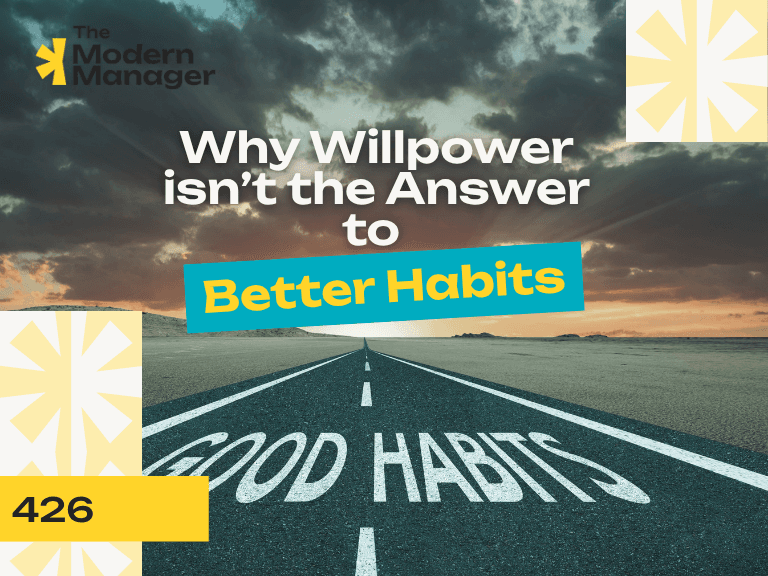
Why Willpower Isn't the Answer to Better Habits
Listen to the entire episode to learn more about how tiny habits rewire your identity
Listen to the full episode →Follow The Modern Manager on your favorite podcast platform so you won't miss an episode!
Most of what happens in your workday isn't a decision. It's a habit. How you open a meeting, how you respond when someone shares bad news, how you close out your emails at the end of the day. These are patterns running on autopilot, and most of us never stop to examine them.
Behavior scientist BJ Fogg has spent decades studying exactly this. He's the founder of Stanford's Behavior Design Lab, the author of Tiny Habits, and the person who coached James Clear years before Atomic Habits existed. His method has now touched tens of thousands of people, and the core insight is almost embarrassingly simple: the way to change your life isn't through willpower. It's through habits so small they're nearly impossible to fail at.
Habits Are Doing More Work Than You Think
BJ splits behavior into two categories. On one end are the big deliberate decisions: who to hire, what the strategic priority is for the quarter. On the other end are habits, the automatic responses that make up most of a workday. The way you greet people. The way you handle a mistake. Whether you share information with your team or quietly sit on it.
Most people never audit that second category. They assume their patterns at work are just personality. BJ’s point is that these patterns are learnable and changeable, the same way any habit is.
Building a Habit Is Not the Same as Breaking One
One useful reframe from the conversation: creating a good habit and eliminating an unwanted one are two entirely different processes. Building is straightforward if you use the right method. Breaking is not, because an unwanted behavior is usually serving some function you haven't recognized yet.
BJ compares habits to a garden. Some plants you're actively growing. Others are weeds, rooted in for reasons that aren't always obvious. His advice is to focus most of your energy on planting good habits. The unwanted ones often lose their space naturally as the good ones take root.
The Real Driver Isn't Discipline, It's Identity
The most striking part of the conversation is what happens after someone builds even one tiny habit. BJ has tracked this with thousands of people who complete his five-day Tiny Habits program. Afterward, he asks them to finish this sentence: Now that I've done this program, I see I'm the kind of person who...
The answers are rarely about flossing or drinking water, even though that’s the type of habit they worked on. They're about identity. I'm the kind of person who can follow through. I'm the kind of person who can change. People who came in believing they had no discipline start believing something different, not because they were told to, but because they have proof, evidence they built with their own actions.
That distinction matters. Convincing yourself you're a different kind of person rarely works. Watching yourself actually behave differently, even in a small way, works because it's true.
"Shine" Is the Missing Ingredient
BJ’s term for the feeling of success right after doing the habit is “shine.”. It might feel silly, but that moment of appreciation is quite powerful. It’s as small as saying "good job" to yourself. Or noticing the room looks a little better. Or anticipating how good it'll feel later now that you’ve done this one action. It sounds almost too simple, and that's the point. Shine is what wires the habit in and what shifts identity alongside it. BJ highlights that when you skip the celebration, the habit stays fragile, no matter how small the behavior was.
What This Means for Managers
As a manager, your praise carries weight. When someone does something well, find the most specific, true thing you can say about it, and say it in a way that names an identity, not just a task. Not just "thanks for the quick turnaround," but "you're the kind of person who follows through fast."
BJ explains that praise like this does three things at once. It makes the person more likely to repeat the behavior. It makes the behavior more automatic. And it reinforces an identity you actually want to see more of on your team.
Where to Start
You don't need a five-day program to test this. Pick one tiny action, something so small it takes less than 30 seconds, and pair it with a genuine moment of feeling good about doing it. Do that consistently, and watch what else starts to shift.
Keep Up with BJ Fogg
Website: https://www.bjfogg.com
Tiny Habits: https://www.tinyhabits.com
Behavior Model: https://www.behaviormodel.org
LinkedIn: https://www.linkedin.com/in/bjfogg/
Social: @bjfogg on most social platforms
Training: Learn Fogg Behavior Design directly from BJ at bjfogg.com/training
The Modern Manager is a leadership podcast for rockstar managers who want to close the gap between knowing what good management is and actually doing it.
Follow The Modern Manager on your favorite podcast platform so you won't miss an episode!